Sumit Pandey
I do research, build products, and write about both.
I'm a postdoc at the University of Copenhagen working on the sustainability and quantization of earth-observation foundation models. Previously: PhD at UCPH on predicting outcomes for comatose patients, Visiting Researcher at the Martinos Center (Harvard/MIT). Joining Neurons as an AI Engineer this June.
Outside research, I build and write. I founded Towards Deep Learning, a weekly journal on Medium, and co-founded thinkidiot and Inquorix.
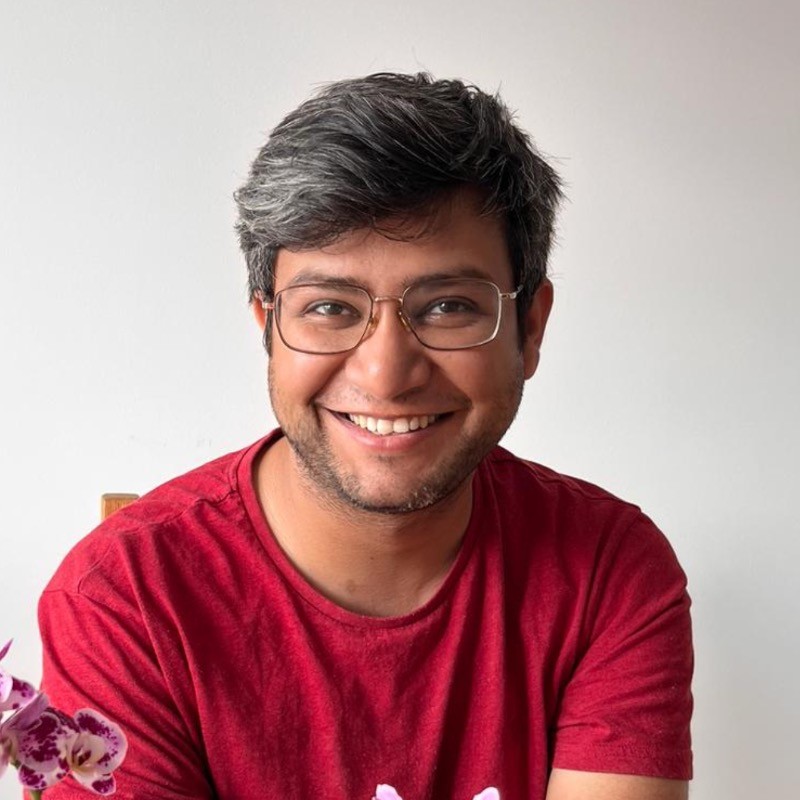
Six years of research and engineering, in Copenhagen, Linkou, and Boston.
Joining the neuromarketing team to build production models predicting consumer attention, emotion, and memory from visual content.
Benchmarking training-free compression for satellite-image foundation models. The question: can we shrink a remote-sensing encoder by 8x and keep retrieval performance intact, so earth-observation AI runs on the edge rather than in a server farm?
Co-built Zero-MED-YOLO, a no-code pipeline for medical-image analysis. What used to take clinicians three hours of manual setup per study now takes under three minutes.
Extended the MED-YOLO project to 2D/3D segmentation on sparse, inconsistently-annotated hospital datasets, the real-world problem that defeats most published architectures. Built the automated preprocessing (skull-stripping, registration, QC) underneath it.
Led the Deep Consciousness project with Rigshospitalet: can a deep model predict whether a comatose patient will survive, given the sequence of CT scans acquired in their first days in the ICU? Across 5,507 patients, the answer was yes. AUROC 0.82 from imaging alone, 0.95 once fused with the Glasgow Coma Scale.
Also ran the ultrasound aorta-segmentation collaboration with Chang Gung Memorial Hospital in Taiwan, and maintained the HPC-side infrastructure that kept both projects moving.
Built CNN, GAN, and U-Net models for MRI cancer segmentation. This was the foundational work that became my first paper in European Radiology (IF 4.7). Also designed the hospital's first deep-learning curriculum for medical residents.
Four things I made that went into production.
Deep Consciousness
A sequential-CT model that predicts survival for comatose patients in their first 72 hours. With Rigshospitalet Copenhagen.
Zero-MED-YOLO
A no-code pipeline for medical-image analysis. Preprocessing, training, and evaluation with a single config file.
GPT-4 Customer Analysis
A GDPR-compliant sentiment and classification system that replaced a 30-hour weekly review cycle with an automated one.
Predictive Maintenance
Maintenance scheduling for hemodialysis machines, combining Weibull reliability analysis with a genetic optimiser.
Peer-reviewed work, mostly on things you can see through a scanner.
Let's build something honest and useful.
I'm always up for a conversation about healthcare AI, foundation models at the edge, or what good ML research actually looks like. Send an email. I read them.